By Elle Bent | December 17, 2025
Exactly one month from today, on January 17, 2026, the UN agreement on the conservation of biodiversity beyond national jurisdiction, or BBNJ Agreement (also referred to as the High Seas Treaty), will enter into force and become international law.
Although the BBNJ Agreement has a long history of negotiations dating back several decades, the text was adopted in June 2023, and the agreement reached another milestone when it received the 60 country ratifications needed for entry into force in September 2025.
The BBNJ Agreement could not have arrived at a more critical time for ocean protection. For centuries, the ocean—two-thirds of which lies in areas beyond national jurisdiction (ABNJ or the “High Seas,” as defined by the United Nations Convention on the Law of the Sea)—has been subject to near-limitless exploitation while facing the triple planetary crises of biodiversity loss, climate change, and pollution.
These threats are only increasing in scale as destructive fishing practices such as bottom trawling mostly continue unchecked, and proposed activities like deep-sea mining threaten to destroy deep-sea and midwater ecosystems. The dynamic, extremely biodiverse expanse of the ocean that is the High Seas has lacked a global mechanism for protection until now.
Notably, the Treaty establishes an international framework for countries to propose and establish area-based management tools (ABMTs) such as marine protected areas (MPAs) on the High Seas. The science shows that MPAs are one of the most concrete and effective ways of conserving biodiversity.
Given the growing number of human activities on the High Seas, the opportunity to establish a network of large-scale, interconnected, and equitably governed MPAs is critical. This network would help safeguard vulnerable, unique, and rare ecosystems and species beyond national jurisdiction—while we still can.
Currently, less than 1% of the High Seas is protected. Existing MPAs in ABNJ include those established under the Commission for the Conservation of Antarctic Marine Living Resources (CCAMLR) and Regional Seas Conventions such as the Oslo and Paris Convention (OSPAR), which established areas in the North Atlantic, primarily to protect seabirds.
Other ABMTs are used to conserve specific species or fish populations, such as those mandated by the 1995 United Nations Fish Stocks Agreement and implemented by Regional Fisheries Management Organizations (RFMOs) to prevent fishing in areas that are considered vulnerable (classified as vulnerable marine ecosystems, or VMEs). The BBNJ Agreement provides a unique opportunity to unify these efforts to protect biodiversity on the High Seas.
Once the agreement’s mechanisms are in place, including the establishment of a Science and Technical Body (STB) to evaluate MPA proposals, a Secretariat, and protocols for the first Conference of the Parties (COP), states will have the opportunity to submit the first MPA proposals for High Seas areas. Many of these “priority areas” have been identified by groups such as the High Seas Alliance and include underwater mountain ranges (seamounts) bustling with marine life, expansive seagrass beds, and areas important for migratory species such as sharks, turtles, seabirds, and whales.
While the best-case scenario would entail BBNJ MPAs that effectively conserve biodiversity, our analysis of current ocean protection levels shows that only 3% of the ocean falls into fully or highly protected MPAs. With only four years left to reach the Kunming-Montreal Global Biodiversity Framework goal of protecting 30% of the ocean by 2030, the urgency to ensure real protections are implemented and actively managed is greater than ever, and MPAs under the BBNJ Treaty risk joining the global trend of ineffective “paper parks” if not implemented and managed effectively.
After 30 years devoted to ocean protection for the greatest benefits to biodiversity and people, Marine Conservation Institute is expanding its efforts to ensure effective protection for the High Seas.
Thanks to generous funding from the Minderoo Foundation, Marine Conservation Institute’s High Seas Program will focus on four areas over the next three years:
1. Supporting the development of strong MPA proposals
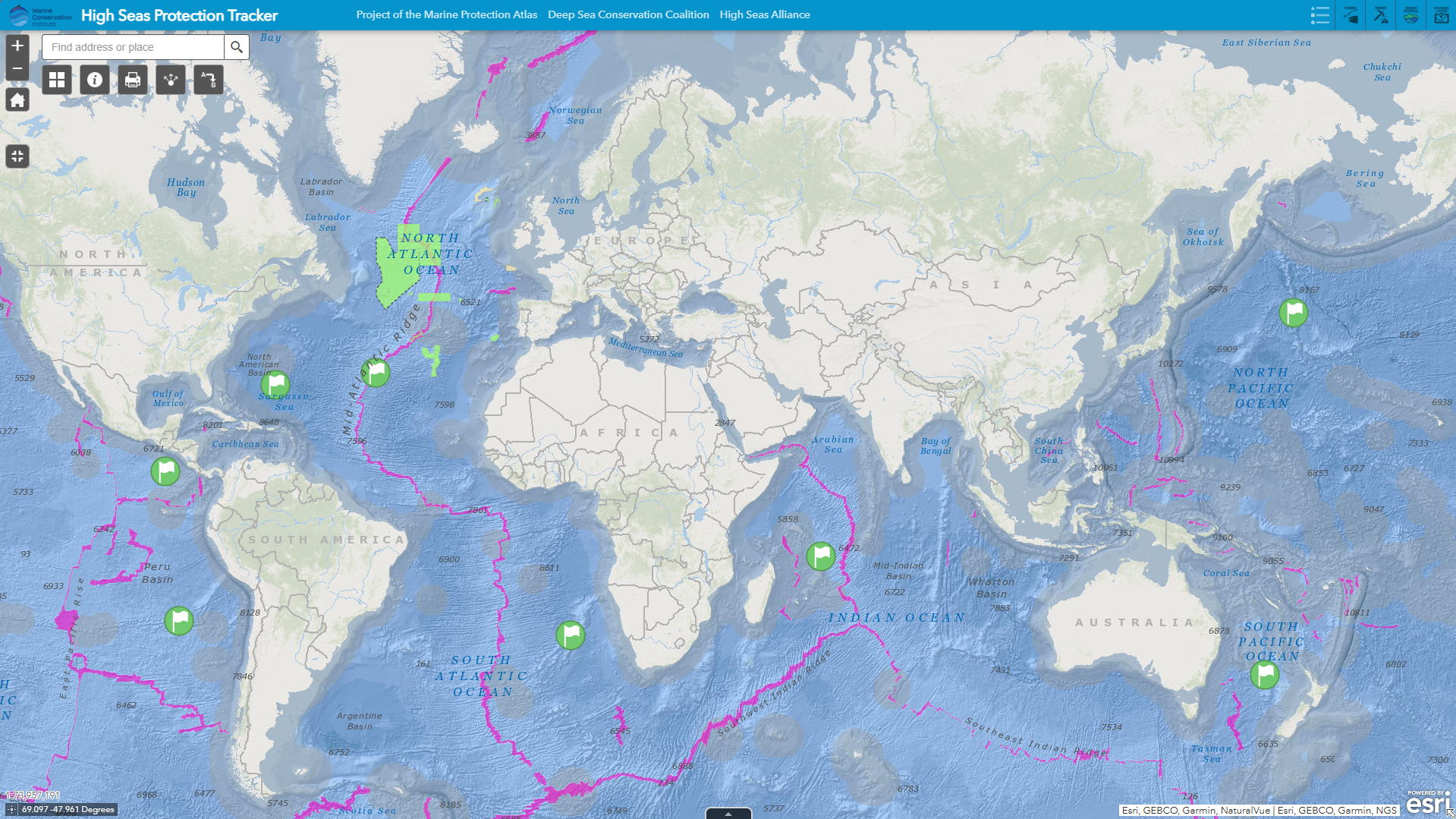
As states begin to develop the first round of MPA proposals under the BBNJ agreement, Marine Conservation Institute will support this process by continuing to engage with partners working on proposals, particularly within coalitions such as the High Seas Alliance, Coral Reefs of the High Seas Coalition, and the Deep Sea Conservation Coalition. Additionally, Marine Conservation Institute staff will be working to update and expand the High Seas Protection Tracker, a tool that provides an overview of existing geospatial data—with an emphasis on ABMTs—in ABNJ. Specifically, this information will support Article 19 of the Treaty (Proposals) Paragraph 4, which mandates that MPA proposals include the following information:
- A geographic or spatial description of the area
- Human activities in the area, including uses by Indigenous Peoples and local communities, and their possible impact, if any;
- A description of the conservation and, where appropriate, sustainable use objectives that are to be applied to the area;
- Information on area-based management tools, including marine protected areas, implemented under relevant legal instruments and frameworks and relevant global, regional, subregional and sectoral bodies.
We are eager to engage with potential users and are open to any feedback (please use this link or email us at info@marine-conservation.org).
2. Assessing the strength of BBNJ MPA proposals
Alongside a global team of MPA experts, Marine Conservation Institute co-developed The MPA Guide, a science-based framework that evaluates MPAs by their level of protection and stage of establishment to predict biodiversity outcomes. By adapting The MPA Guide for the High Seas and applying it to assess prospective BBNJ MPA proposals, we aim to serve as an independent evaluator and advocate for the strongest, most effective protections for ocean biodiversity, while supporting governments, Indigenous peoples and local communities, and NGOs in developing robust, equitable proposals whenever possible.
3. Tracking BBNJ MPA progress and reporting on gaps through the Marine Protection Atlas (MPAtlas)
We use The MPA Guide to assess marine protected areas and share our findings through the global database Marine Protection Atlas (MPAtlas.org). MPAtlas is the world’s most trusted source for tracking the effectiveness of MPAs and provides the widely cited statistic that only 3% of the ocean is effectively implemented and protected. Looking ahead, we aim to evaluate and track BBNJ MPA proposals (and eventually, their implementation) on MPAtlas to report on progress toward 30x30 goals and highlight areas where further action is needed.
4. Advocating for effective BBNJ MPAs that afford protections for the whole water column
Based on the outcomes of our assessments, we will advocate for fully and highly protected BBNJ MPAs that result in positive biodiversity outcomes, involve a thorough consultative process with Indigenous peoples and local communities, and are representative of the many diverse ecosystems and habits that make up the High Seas. We also support MPAs that protect the entire water column—from the seabed to the surface—encompassing the full diversity of ocean life. Along with the Environmental Defense Fund and Ocean Conservancy, Marine Conservation Institute proposed IUCN Motion 035 at the World Conservation Congress to protect the mesopelagic, or “ocean twilight zone,” the zone of the ocean that spans from 200 to 1000 meters deep. This critical zone, as well as the rest of the deep ocean, should be meaningfully included in High Seas protections.
The BBNJ Agreement’s imminent entry into force marks a historic opportunity to finally safeguard the High Seas and the extraordinary life it holds. But that promise is not guaranteed. Without ambitious, science-based protections and meaningful implementation, the agreement risks becoming another missed opportunity instead of the transformative tool the ocean needs.
Marine Conservation Institute is determined to help ensure that does not happen. By supporting strong, well-designed MPA proposals, independently assessing their strength, tracking real progress toward 30x30, and advocating for fully and highly protected, whole–water column MPAs, we will work to make sure the BBNJ Agreement delivers on its potential.
To learn more about our High Seas Program work, visit: https://marine-conservation.org/high-seas/